


Luminescense Laboratory
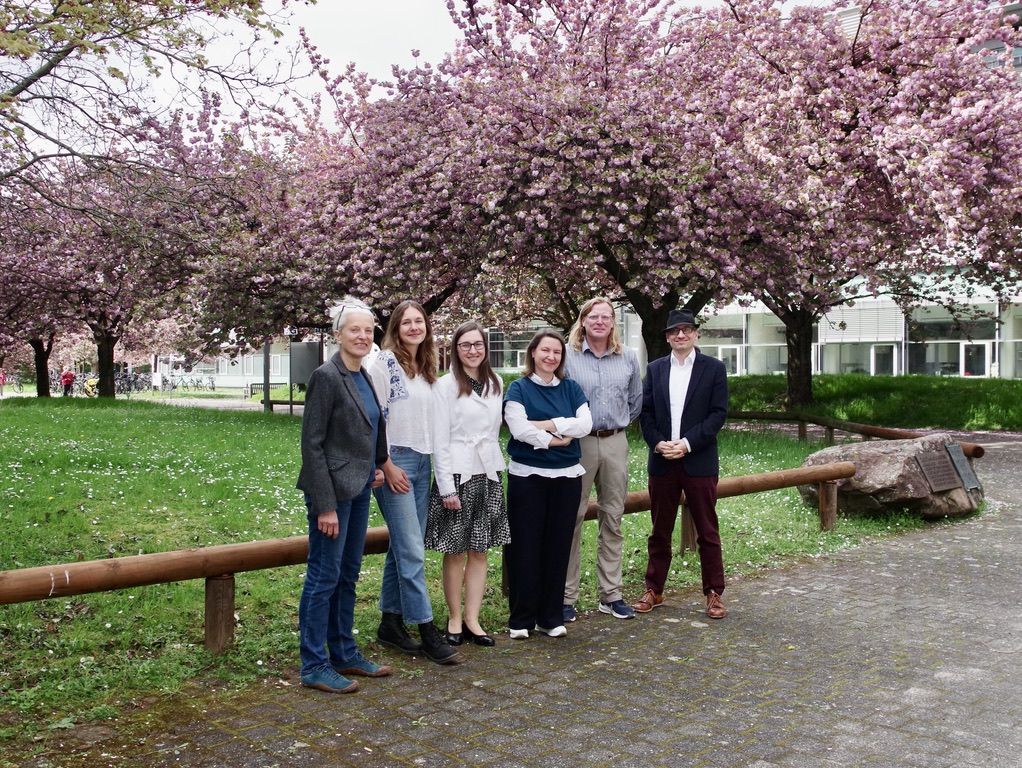
The heiLUM team as of 2023-04-19 (from left to right): Dr Annette Kadereit (director of heiLUM), Lea Stoffl (student assistant), Dr Magdalena Biernacka (Marie-Curie PostDoc), Jutta Asmuth (lab manager), Prof Paul Hanson (guest heiLUM), Sebastian Kreutzer (Heisenberg Group Leader). Missing on the photo: Marlène Bultel (student assistant)
The Heidelberg Luminescence Laboratory at the Institute of Geography conducts optical dating of sediments and stone surfaces as well as scientific and technological development of the optical stimulated luminescence technique.
| Method | Current Publications | Project Cooperations |
Luminescence dating is a dosimetric dating technique based on the steady decay of radionuclides present almost everywhere in the natural environment and the steadily increasing radiation damage caused in non-conductors, like mineral grains. The natural radioactivity functions as a driving clockwork and the mineral grains serve as a readable clock. The clock ticks within sedimentary deposits and other archives which are used by researchers in the palaeo-environmental and archaeological sciences to reconstruct the evolution of a landscape, the history of an archaeological site or the interaction of man and his environment in the geological and historical past, in disciplines such as geomorphology, geoarchaeology and archaeometry. [read more]
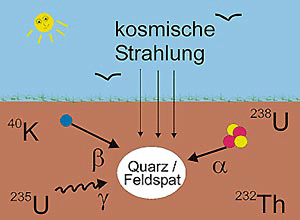
Fig. 1: Ionizing radiation in a soil or sediment
Dating is performed with common quartz and feldspar grains that are found more or less ubiquitously on the earth's surface. As a result of the radioactive decay of the radionuclides (mainly 40K and 87Rb) and the radioactive decay chains (mainly from 238U, 235U and 232Th) present in a sedimentary deposit, an ionizing radiation is emitted which leads to measurable radiation damages within the crystal lattices of the quartz and feldspar minerals (Fig. 1). Within the non-conductors the activated electrons are lifted from the valence band to the conduction band and may be trapped at lattice defects where they are stored in meta-stabile states (Fig. 2, top). The larger the amount of trapped electrons is, the longer was the time during which mineral grains were exposed to the ionizing radiation.

Fig. 2: Filling and emptying of OSL-traps as illustrated by the energy-band model
The geo-clock may be read by using luminescence techniques. By supplying energy, the trapped electrons are released from their meta-stable states whereupon they recombine by emitting a cold light: the luminescence signal (Fig. 2, bottom). Depending on the kind of stimulating energy, the technique is called thermally-stimulated luminescence (TL) or optically-stimulated luminescence (OSL) dating. Further specification is possible with respect to the stimulating wavelength, e.g. in the near infrared (infrared-stimulated luminescence = IRSL) or in the visible range, such as, e.g. by blue LEDs (blue-light stimulated luminescence = BLSL). As the strength of the luminescence signal corresponds to the number of trapped electrons which correlate with the time of exposure to the ionizing radiation it is possible to use luminescence techniques for the dating of sediments. Generally, an older sample delivers a stronger luminescence signal than a younger sample. The correlation between the amount of energy a crystal has received, which is denoted in kilojoule per kilogram (kJ/kg) or Gray (Gy), and the strength of the corresponding luminescence signal has to be determined and calibrated for each sample individually. This is done by the construction of a growth-curve, for which the strengths of the luminescence signals of a sample are plotted against known doses administered to the sample in the laboratory using calibrated radioactive sources (Fig. 3). By fitting the strength of the natural luminescence signal of a sample into the sample's growth curve the palaeodose (also equivalent dose (DE)) is then calculated. In order to determine the age of a sample, we also need to know the strength of the ionizing radiation per time-unit (e.g. per thousand years = 1 ka), i.e. the environmental dose rate (Gy/ka). The dose rate can be measured using low level gamma spectrometry, or alpha-counting and beta-counting, or a combination of these. The age of a sample may be calculated according to the simplified age-equation:
age [ka] = dose [Gy] ⁄ dose rate [Gy/ka]
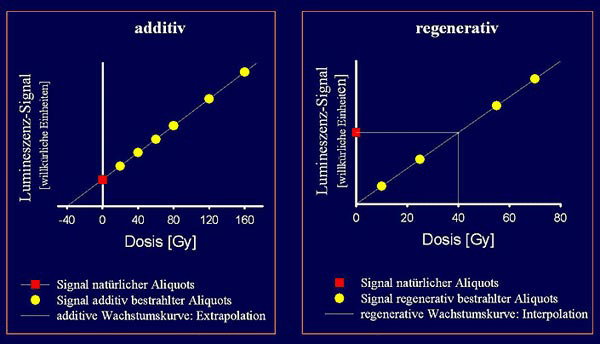
Fig. 3: Additive (left) and regenerative (right) growth curve
